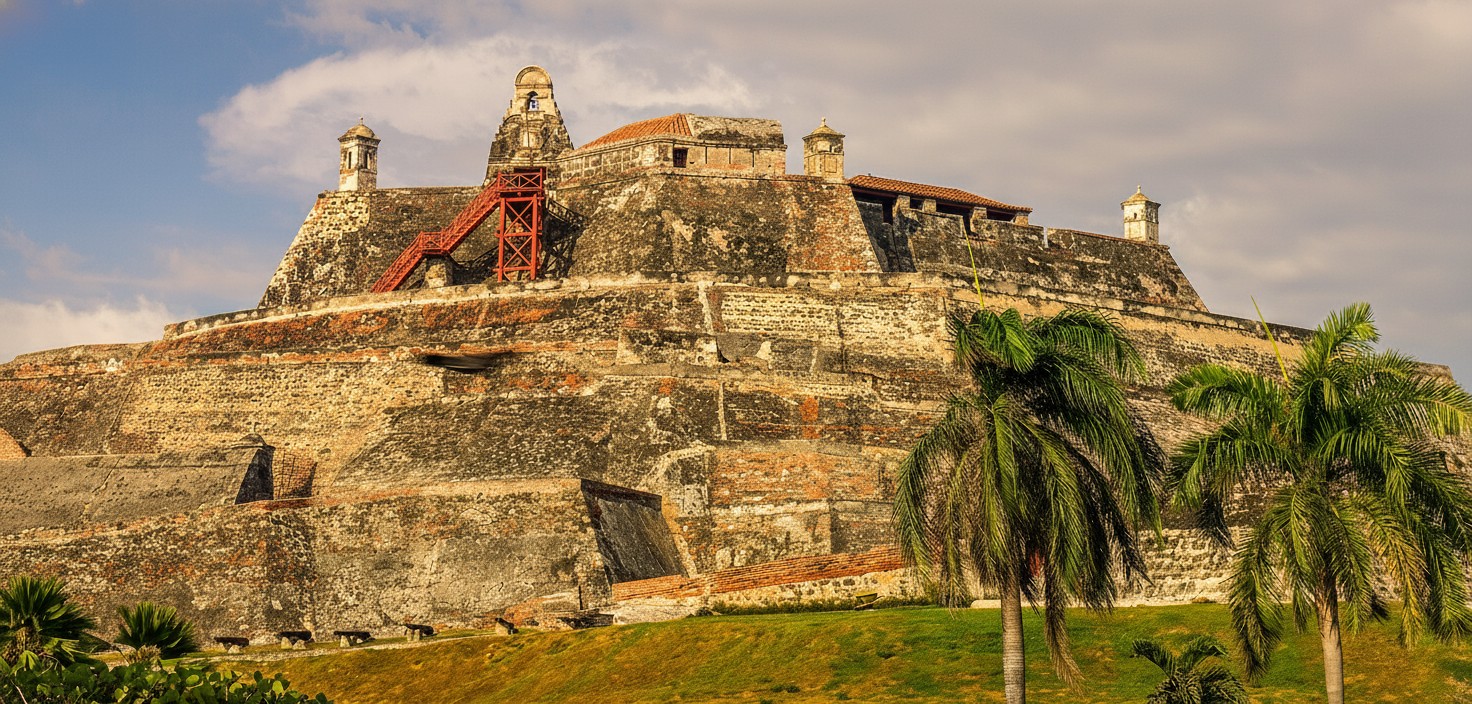
Most Castillo San Felipe guides tell you “it’s an impressive fortress” without explaining that showing up at noon in Caribbean heat means you’ll spend half your visit recovering from the uphill walk rather than appreciating the engineering, or that the tunnel system is the real attraction but half the tourists miss it entirely because signage is unclear.
The Castillo San Felipe is Cartagena’s most impressive historical site – a massive Spanish colonial fortress with underground tunnels, strategic positioning, and fascinating military engineering. The best experience requires specific timing (early morning before heat and cruise ship crowds), proper transport (Uber up the hill, don’t walk), and understanding what you’re looking at (the tunnels and acoustic system are more interesting than the walls themselves). Entry takes 60-90 minutes if you explore thoroughly, less if you skip the tunnels.
This guide breaks down everything about visiting the castle – the history that makes it interesting, the engineering features to look for, when to visit to avoid crowds and heat, how to reach it without arriving exhausted, the tunnel system that most people rush through, and honest expectations about what you’ll see.
Planning your castle visit? After understanding the fortress, see our 3-day itinerary to understand where it fits in your schedule, or check our getting around guide for detailed transport strategies to reach the site.
Why the Castle Matters
Before visiting, understand what you’re seeing:
The Strategic Context:
Location importance:
- Cartagena = major Spanish port (1500s-1800s)
- Shipped gold/silver from South America to Spain
- Pirates attacked constantly (Francis Drake, others)
- Spanish needed to protect the treasure route
The solution:
- Build massive fortress on hill
- Overlooks entire city and bay
- See enemy ships approaching
- Defend against land and sea attacks
The result:
- Never successfully conquered by direct assault
- Withstood multiple sieges
- Most impressive Spanish military architecture in the Americas
- UNESCO World Heritage Site
What Makes It Special:
Engineering achievements:
- Underground tunnel system (acoustic communication)
- Strategic positioning (360-degree views)
- Multiple defensive layers
- Water collection systems
- Ammunition storage
- Living quarters for garrison
The innovation:
- Tunnels allow troops to move unseen
- Acoustic design lets voices carry between positions
- Multiple fallback positions
- Self-sufficient during sieges
Historical significance:
- Best-preserved Spanish fortress in Americas
- Example of military architecture evolution
- Withstood famous sieges (1741 British attack)
- Symbol of Spanish colonial power
What You’ll Actually See
Setting realistic expectations:
The Fortress Structure:
Outer walls:
- Massive stone fortifications
- Ramparts for cannons
- Defensive positions
- Multiple levels
Summit:
- Highest point
- Flag flying
- 360-degree views
- Main defensive position
Tunnels (underground system):
- Network of passages
- Acoustic features
- Troop movement routes
- Storage areas
- This is the most interesting part
Buildings:
- Former barracks
- Ammunition storage
- Officer quarters
- Chapel
The Experience:
What’s impressive:
- Scale of construction (it’s enormous)
- Engineering ingenuity (tunnels especially)
- Views over Cartagena
- Historical significance
- Condition (well-preserved)
What’s less impressive:
- Empty inside (no period furnishings)
- Limited exhibits (mostly just the structure)
- Signage could be better (easy to miss things)
- Gets very hot (exposed stone, Caribbean sun)
The pattern: It’s architecture and engineering, not a museum with artifacts. You’re appreciating the structure itself, the strategic positioning, and imagining historical context.
The Tunnel System: Don’t Miss This
The tunnels are the highlight but many visitors rush through:
What They Are:
Purpose:
- Move troops between positions without being seen
- Communication via acoustics
- Escape routes if walls breached
- Storage during sieges
- Protect from bombardment
Engineering:
- Carved through solid rock
- Multiple levels
- Strategic intersections
- Acoustic design (voices carry)
The Acoustic Feature:
How it works:
- Specific tunnel points have acoustic properties
- Voice at one end carries to another point
- No electric communication in 1700s
- Soldiers could coordinate across fortress
Where to experience it:
- Marked positions in tunnels
- Stand at designated spot
- Speak normally
- Friend at other end hears clearly
- Test this – it’s cool
Exploring the Tunnels:
Entry points:
- Multiple access points from main fortress
- Signage exists but not always obvious
- Ask attendants if you can’t find them
Inside:
- Cool (relief from heat outside)
- Dark (bring phone light)
- Low ceilings in places (watch head)
- Uneven floors (watch step)
- Takes 15-20 min to explore properly
Why people skip them:
- Don’t realize they’re there
- Entrance not obvious
- Assume it’s just storage
- Rushing through site
Don’t skip them: The tunnels are the most interesting part. Many visitors leave saying “nice fortress” without seeing the best feature.
Timing Your Visit: When to Go
Time of day dramatically affects experience:
Best Time: Early Morning (8-9 AM)
Why it’s ideal:
- Opens at 8 AM
- Coolest part of day
- Almost empty (beat cruise ship crowds)
- Better photography (soft morning light)
- Full energy to explore
- Can take your time
How to do it:
- Uber from hotel around 7:45 AM
- Arrive right at opening
- First in = almost private tour
- Finish by 10 AM before heat/crowds
This is the single best strategy.
Acceptable: Late Afternoon (4-5 PM)
Why it works:
- Cruise ships have left
- Heat starting to drop
- Crowds thinning
- Closes at 6 PM (limited time)
Trade-offs:
- Still hot (but less brutal)
- Less time to explore
- Afternoon light harsh for photos
- May feel rushed
Avoid: Midday (10 AM – 3 PM)
Why it’s terrible:
- Peak heat (brutal)
- Cruise ship crowds (packed)
- Exposed stone reflects heat
- No shade on ramparts
- Exhausting
- Photos washed out (harsh light)
Reality check: Visiting at noon in Caribbean sun is genuinely unpleasant. The stone fortress becomes an oven. You’ll spend more time seeking shade than exploring.
Day of Week:
Best: Weekdays (fewer crowds)
Busy: Weekends (domestic tourists)
Packed: When cruise ships in port (check schedules)
Cruise ship days:
- 2-3 ships in port = hundreds of tourists at castle
- Peak 10 AM-2 PM
- Go early to beat them or late after they leave
Getting There: Transport Strategy
The castle sits on a hill 2.5 km from Old Town:
Option 1: Uber (Recommended)
Why it’s best:
- 10-12 min from Old Town
- Drops you at entrance
- Arrive fresh (not sweaty)
- Very affordable
- Can enjoy fortress without exhaustion
How it works:
- Request Uber to “Castillo San Felipe de Barajas”
- Driver knows it
- Drops at parking area
- Walk 2 min to entrance
- Easy
Return:
- Order Uber from parking area
- Usually available in 3-5 min
- Or walk down (downhill easier than up)
Option 2: Walking (Not Recommended)
Distance: 2.5 km from Old Town
Time: 30+ minutes
Challenge: Uphill the entire way
Why people think they’ll walk:
- “It’s only 2.5 km”
- “I like walking”
- “Exercise is good”
Why they regret it:
- Uphill entire way (it’s called a fortress on a hill for a reason)
- 30+ min in Caribbean sun
- No shade for long stretches
- Busy road (not pleasant)
- Arrive drenched in sweat
- Too exhausted to enjoy fortress
- Need 20 min recovery before exploring
Honest take: I’ve seen dozens of tourists attempt this walk. They arrive miserable, spend their visit recovering, take bad photos because they’re sweaty/exhausted, and wish they’d just Ubered. The Uber costs very little and preserves your energy for actually exploring.
For complete transport breakdown and why walking long distances in Cartagena heat is problematic, see our getting around guide.

Option 3: Organized Tours
What they include:
- Hotel pickup
- Guide explaining history
- Transport both ways
- Sometimes combined with city tour
Advantages:
- Zero logistics
- Learn more (guided explanation)
- Don’t need to research
- Social (meet other travelers)
Disadvantages:
- Cost more than DIY
- Fixed schedule (can’t linger or leave early)
- Group pace (may be rushed or too slow)
- Often midday timing (worst heat)
When it makes sense:
- First time visitors wanting full context
- History buffs who want detailed explanation
- Anyone who values guided experience
Entry & Practical Details
What to know before arriving:
Entry Process:
Ticket booth:
- At entrance (can’t buy online ahead)
- Cash or card accepted
- Keep ticket (may check inside)
Entry cost pattern:
- Modest (cheap compared to Western attractions)
- Significantly less than European castle entries
- Good value for what you see
Duration:
Quick visit: 30-45 min
- Walk ramparts
- See main views
- Skip tunnels (mistake!)
Thorough visit: 60-90 min
- Explore tunnels properly
- Read all signage
- Take photos
- Sit and absorb
- Recommended
With guide: 90-120 min
- Detailed historical context
- All features explained
- Questions answered
What to Bring:
Essential: ✅ Water (no vendors inside, you’ll need it)
✅ Sunscreen (reapply during visit)
✅ Hat/sunglasses (exposed to sun)
✅ Phone (photos, tunnel light)
✅ Comfortable shoes (uneven surfaces, stairs)
Nice to have: ✅ Small backpack (hands-free climbing)
✅ Portable fan (heat relief)
✅ Light clothing (breathable)
Not needed: ❌ Umbrella (rain rare, and you can’t use inside)
❌ Snacks (eating not allowed inside)
Accessibility:
Challenge:
- Multiple levels (stairs required)
- Uneven surfaces (cobblestones)
- Steep ramps in places
- Tunnels have steps
- Not wheelchair accessible
If mobility limited:
- Lower levels only might be possible
- Views from bottom still worthwhile
- Discuss with attendants on arrival
- Skip tunnels (stairs required)
What to Look For: Making It Interesting
The castle is more fascinating when you know what you’re seeing:
Defense Systems:
Multiple walls:
- Outer perimeter (first defense)
- Inner walls (fallback positions)
- Summit (final defensive position)
- Attackers had to breach multiple layers
Cannon positions:
- Strategic placement
- Overlapping fields of fire
- Different elevations
- Notice the angles
Observation points:
- See the bay (spot incoming ships)
- See land approaches
- 360-degree awareness
- No blind spots
Engineering Features:
Water collection:
- Cisterns built into structure
- Rainwater channeled and stored
- Self-sufficient during sieges
- Some visible if you look
Ventilation:
- Tunnels designed for air flow
- Barracks positioned for breeze
- Strategic openings
Construction:
- Stone blocks (shipped from elsewhere)
- Mortar techniques
- How they built on bedrock
- Scale of labor (took decades)
Historical Markers:
1741 British Siege:
- Admiral Vernon attacked with 180 ships
- 3,000 Spanish defenders vs 27,000 British
- British failed to take fortress
- Major Spanish victory
- Look for commemorative plaques
Different construction phases:
- Original fort (1600s)
- Expansions over decades
- You can see different building periods
- Architecture evolved
The Views:
What you see:
- Old Town (walled city)
- Caribbean Sea
- Modern Cartagena
- Bocagrande towers
- Bay entrance
- Surrounding hills
Best photo spots:
- Summit (highest point)
- Western ramparts (Old Town view)
- Eastern side (Caribbean view)
Golden hour:
- Morning: 6:30-7:30 AM (before it opens, but nice light when you arrive early)
- Evening: 5-6 PM (last hour open, beautiful light)

Photography Tips
Making the most of photo opportunities:
Best Shots:
The fortress from below:
- Approach shot (captures scale)
- Morning light ideal
- Shows hillside position
Rampart views:
- Looking out over Cartagena
- Caribbean in background
- Wide angle helpful
Tunnel interiors:
- Dark, need phone light
- Creates atmosphere
- Careful with footing while shooting
Flag at summit:
- Colombian flag flying
- Blue sky background
- Patriotic shot
Stone details:
- Weathered walls
- Cannon positions
- Architectural elements
Technical Tips:
Light:
- Morning = soft, even (best)
- Midday = harsh, washed out (worst)
- Afternoon = warm, long shadows (okay)
Composition:
- Include people for scale
- Use walls to frame views
- Leading lines (ramparts guide eye)
Equipment:
- Phone camera sufficient
- Wide angle useful (structure is big)
- Zoom not necessary (you’re close to everything)
Guided vs Self-Guided
Deciding whether you need a guide:
Self-Guided Advantages:
✅ Free (just entry cost)
✅ Go at your own pace
✅ Linger where you want
✅ Leave when satisfied
✅ No group schedule
Works well if:
- You’ve read up on history (like this guide!)
- Comfortable exploring independently
- Prefer flexibility
- Budget-conscious
Guided Tour Advantages:
✅ Historical context explained
✅ Stories bring it alive
✅ See things you’d miss
✅ Ask questions
✅ Social experience
Works well if:
- History buff wanting details
- First visit to any fortress
- Prefer structured experience
- Value expert interpretation
Compromise Option:
Hire guide on-site:
- Freelance guides at entrance
- Negotiate directly
- Flexible timing (not locked into tour schedule)
- Can end early if satisfied
- Personal attention (not group of 30)
Pattern: Many visitors prefer this middle ground – guided explanation with flexibility.
Common Mistakes
What visitors get wrong:
Mistake #1: Walking Up in Heat
The trap: “I’ll walk to save money”
The reality: Arrive exhausted, can’t enjoy site
The fix: Uber costs very little, preserves energy for actual fortress
Mistake #2: Visiting at Midday
The trap: “I’ll go after lunch”
The reality: Brutal heat + cruise ship crowds
The fix: 8-9 AM or 4-5 PM
Mistake #3: Missing the Tunnels
The trap: Walk ramparts, think you’ve seen it all
The reality: Tunnels are the most interesting feature
The fix: Ask attendants for tunnel entrance, spend 15-20 min exploring
Mistake #4: Rushing Through
The trap: “It’s just a fort, 30 minutes is enough”
The reality: Miss most of the interesting details
The fix: Budget 60-90 min, explore thoroughly
Mistake #5: No Water
The trap: “I don’t need water, it’s not that far”
The reality: Hot, exposed, Caribbean sun, dehydration risk
The fix: Bring water bottle, drink regularly
Mistake #6: Wrong Shoes
The trap: Flip-flops or unsupportive shoes
The reality: Uneven surfaces, stairs, tunnels
The fix: Comfortable walking shoes with support
Combining with Other Activities
The castle fits naturally into daily schedules:
Morning Castle, Afternoon Old Town:
Timeline:
- 7:45 AM: Uber to castle
- 8:00 AM: Enter (first visitors)
- 9:30 AM: Finish exploring
- 10:00 AM: Back to hotel/Old Town
- 10:30 AM+: Rest of day for other activities
Why it works:
- Castle done before heat
- Entire afternoon free
- Still have energy
The castle and the walled Old Town sit about ten minutes apart by taxi, and the Getsemani side is closer still, which is why this pairing works better than trying to add a beach.
For complete daily schedule showing how castle fits with other activities, see our 3-day itinerary.
Combined Day Trip:
Castle + City Tour:
- Morning castle visit
- Lunch break
- Afternoon Old Town guided tour
- Evening free
Castle + Beach:
- Early castle (8-10 AM)
- Return to hotel
- Afternoon Bocagrande beach
- Evening dinner
Is It Worth It?
Honest assessment for different travelers:
Definitely Worth It If:
✅ You like history
✅ You appreciate military architecture
✅ You want views over Cartagena
✅ You’re interested in colonial era
✅ You have 3+ days in Cartagena
✅ You visit early morning (optimal experience)
Maybe Worth It If:
⚠️ You’re indifferent to history (the views alone are nice)
⚠️ You only have 2 days (other priorities might be better)
⚠️ Hot weather bothers you significantly (even morning gets warm)
Skip It If:
❌ You have only 1 day (Old Town + islands more important)
❌ You hate history/architecture (won’t appreciate it)
❌ Mobility issues prevent stairs/climbing (inaccessible)
❌ You’ve seen many European castles (this won’t blow your mind)
Value Assessment:
Entry cost: Very reasonable for what you see
Time investment: 60-90 min well spent
Transport cost: Minimal (Uber both ways)
Overall verdict: One of Cartagena’s must-see attractions if you have time
Comparison:
- Better than: Most Cartagena museums (limited)
- Equal to: Old Town walking (different experience)
- Not as good as: Rosario Islands (if you love beaches)
For complete activity priority ranking and how to allocate days, see our comprehensive activities guide.
Full Visit Plan: Castillo San Felipe de Barajas
Arrive just before 8am opening. Morning light is perfect for photos and the heat is still manageable.
Buy tickets (38,000 COP full rate for foreign visitors, 2026). Pick up the map. Start at the main ramp to understand the scale.
The highlight: underground tunnels with remarkable acoustics. Cool, atmospheric and fascinating.
Climb to the highest platforms for panoramic views over Cartagena Bay and the Old Town walls below.
Best morning light before heat haze builds. Shoot the walls, tunnel entrance, and the bay views.
Leave before 11am heat and tour bus arrivals. You’ve seen everything worth seeing.
The castle is 10 minutes from the walled city. Continue your day in the Old Town.
The Honest Takeaway
Castillo San Felipe is Cartagena’s most impressive historical site and worth visiting if you do it right:
Timing is everything. Visit at 8 AM when it opens and you’ll have an almost-private exploration of a massive fortress, cool morning air, no crowds, and the energy to actually appreciate what you’re seeing. Visit at noon and you’ll be one of hundreds of sweaty tourists rushing through to escape the heat. The experience quality difference is night and day.
The tunnels are the highlight, not the walls. Most visitors walk the ramparts, take photos of views, and leave thinking “nice fort.” The underground tunnel system with acoustic features and strategic passages is the most interesting part, but signage doesn’t make it obvious. Ask attendants for tunnel entrance, bring phone light, spend 15-20 minutes exploring. The engineering ingenuity is more impressive than the stone walls.
Don’t walk there. It’s 2.5 km uphill in Caribbean sun. The Uber costs very little and means you arrive fresh instead of exhausted. Every tourist who walks it regrets it. This isn’t being lazy – it’s smart energy management so you can actually enjoy the site you came to see.
Budget 60-90 minutes minimum. Quick 30-minute visit means you miss the tunnels, rush the ramparts, and don’t absorb the history. The fortress took decades to build and never fell to enemies despite multiple sieges. Give it time to appreciate the scale and significance.
Historical context matters. With basic understanding of why it was built (protect gold shipments from pirates), how it worked (multiple defensive layers, acoustic communication), and its significance (withstood famous 1741 British siege), the fortress becomes fascinating. Without context, it’s just old walls. Read up beforehand or hire a guide.
The castle delivers if you respect the timing (early morning), prepare properly (transport, water, comfortable shoes), and explore thoroughly (tunnels!). It’s not a world-changing sight like Machu Picchu, but it’s an impressive example of Spanish colonial military engineering and offers excellent views over Cartagena. For history and architecture enthusiasts, it’s a clear highlight. For beach-only travelers, it might be skippable.
Ready to plan your castle visit? See how it integrates into realistic daily schedules in our 3-day Cartagena itinerary, which shows optimal timing for the fortress combined with other activities.
Related Guides
For planning your complete Cartagena trip:
- 3-Day Cartagena Itinerary – Castle timing in daily schedule
- Things to Do in Cartagena – Activity priority ranking
- Getting Around Cartagena – Transport to castle
- When to Visit Cartagena – Weather considerations
- Where to Stay in Cartagena – Distance from castle by neighborhood
- Is Cartagena Safe? – General safety context
- Cartagena Budget Guide – Activity cost patterns